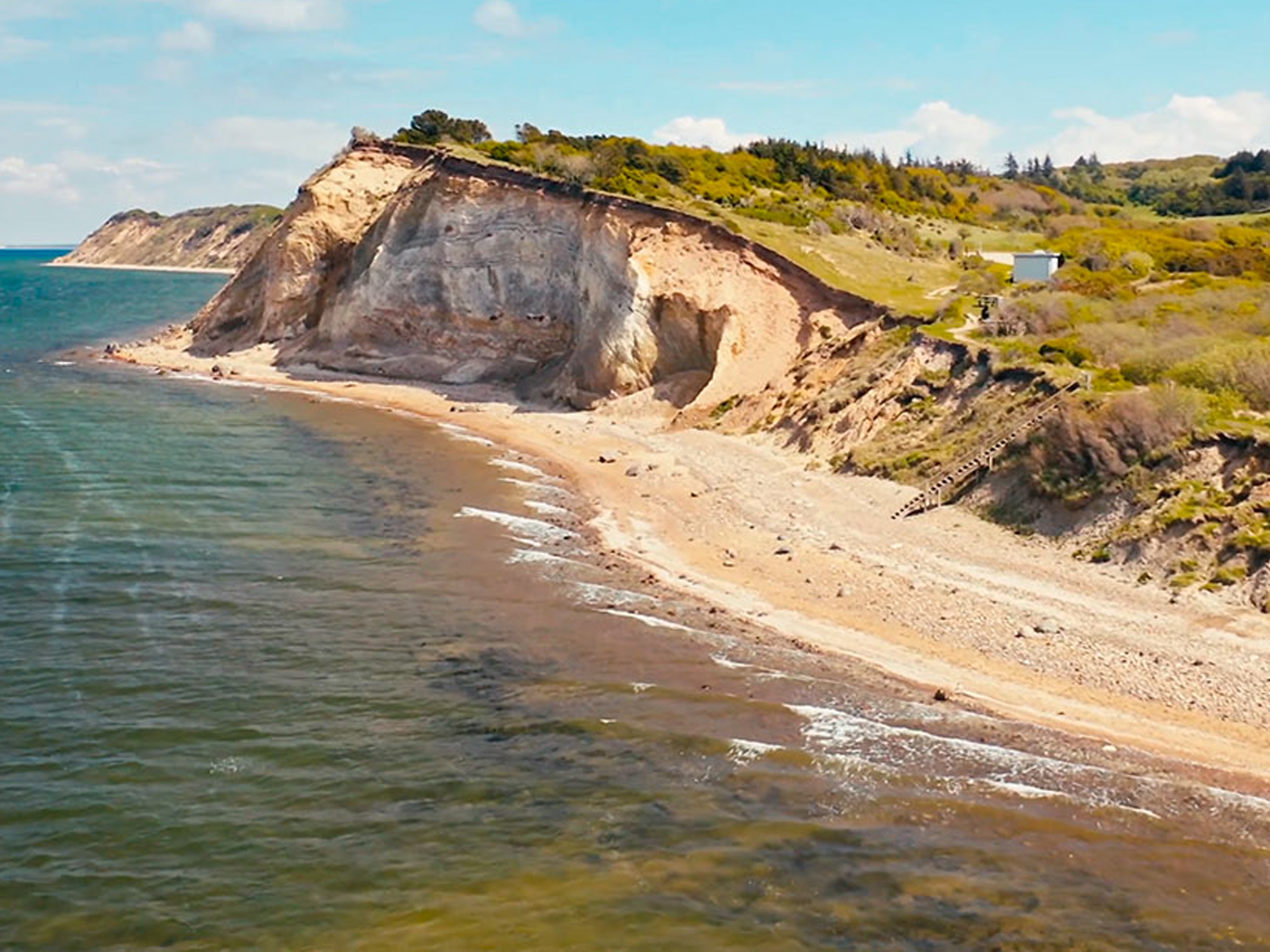
Knudeklint - UNESCO World Heritage Site at the Limfjord
Knudeklint on Fur is one of Denmark's most spectacular natural experiences. Together with Hanklit on Mors, it is a UNESCO World Heritage Site as part of the Western Limfjord area - a place where 55 million years of geological history is exposed in the steep cliffs.
Når du står ved Knudeklint, ser du ikke blot en smuk kystklint. Du ser resterne af en urgammel havbund, hvor vulkansk aske, mikroskopiske kiselalger og et enestående dyre- og planteliv blev bevaret lag for lag. Det gør
Knudeklint is one of the world's most important places for understanding the development of life after the extinction of the dinosaurs, especially the evolution of fish is of a unique nature.
Experience Denmark's most complete mole cliff
Knudeklint is located on the northwestern part of Fur and stretches for about one kilometer along the Limfjord. The cliff rises up to 35 meters above the water and is the most complete mole cliff in Denmark.
The characteristic light layers of moles are intersected by dark ash layers from volcanic eruptions that occurred about 55 million years ago.
Each layer tells a part of the story of a time when the climate was tropical, volcanoes were active, and life on Earth was resurfacing after one of the planet's largest mass extinctions.
It is precisely this unique geological story, with the fish as a core value, that has secured Knudeklint and Hanklit a place on the UNESCO World Heritage List.
That's why Knudeklint is a UNESCO World Heritage Site.
Knudeklint contains some of the world's best-preserved fossils from the early Eocene period. More than 700 species of fish, birds, insects, plants and other organisms have been found in the mole, giving scientists a whole new world of fossils.
Special insight into the evolution of life and the Earth's climate millions of years ago.
The many fossils are preserved in a quality that is found only in a few places in the world. At the same time, the cliff documents a period of significant climate change that is still relevant for research into today's climate development.
Therefore, UNESCO has recognized the Western Limfjord as an area of outstanding universal value for all humanity.
A nature experience with a view of the Limfjord
Knudeklint is not only interesting for geologists. The area also offers magnificent views of the Limfjord, dramatic coastal landscapes and a tranquility that makes a visit a very special nature experience.
Here you can experience the striking folds in the landscape, which were created during the last ice age, while the ocean waves continue to keep the cliff free of vegetation and expose the millions of years old layers.
Whether you are interested in nature, history, hiking or photography, Knudeklint is a place that impresses all year round.
Fossils and piers – a window to the past
The mole at Knudeklint consists of microscopic diatoms mixed with volcanic ash.
Millions of years ago, the special conditions on the seabed created an almost oxygen-free world where dead animals and plants were preserved in exceptionally high quality.
That is precisely why the area is world-renowned among researchers, and the findings from Knudeklint have contributed important knowledge about both evolution and climate change.
The cliff itself is protected, and fossils are therefore not allowed to be collected here, only on the beach. If you want to try your hand at fossil hunting yourself, there are several places on Fur and Mors where it is allowed.
Discover more at Fur
A visit to Knudeklint can easily be combined with other experiences on Fur.
Visit the Fossil and Millers Museum and gain even greater insight into the area's geological history, go fossil hunting in the former millers' pits, or experience Fur Bryghus, the cozy harbor environments and the island's many hiking and cycling routes.
If you want to experience the entire UNESCO area, the trip can continue to Hanklit on Mors, where Denmark's largest mole cliff shows another part of the same fascinating story of the Western Limfjord. UNESCO is impressed by our way of offering access to everyone, as well as the Danish cattle scheme that ensures the uniqueness of the museums' collections.
Practical information
Knudeklint is a protected natural area. Help take care of the world heritage by staying on the trails, respecting nature and leaving the fossils where they are.
Here you will get a world-class nature experience – a place where millions of years of history lie right at your feet, and where UNESCO World Heritage brings the past up close.

